Break-even ROAS formula: a worked example and a margin table
One division tells you the ROAS below which your ads lose money. The catch is which margin you use.
The short answer
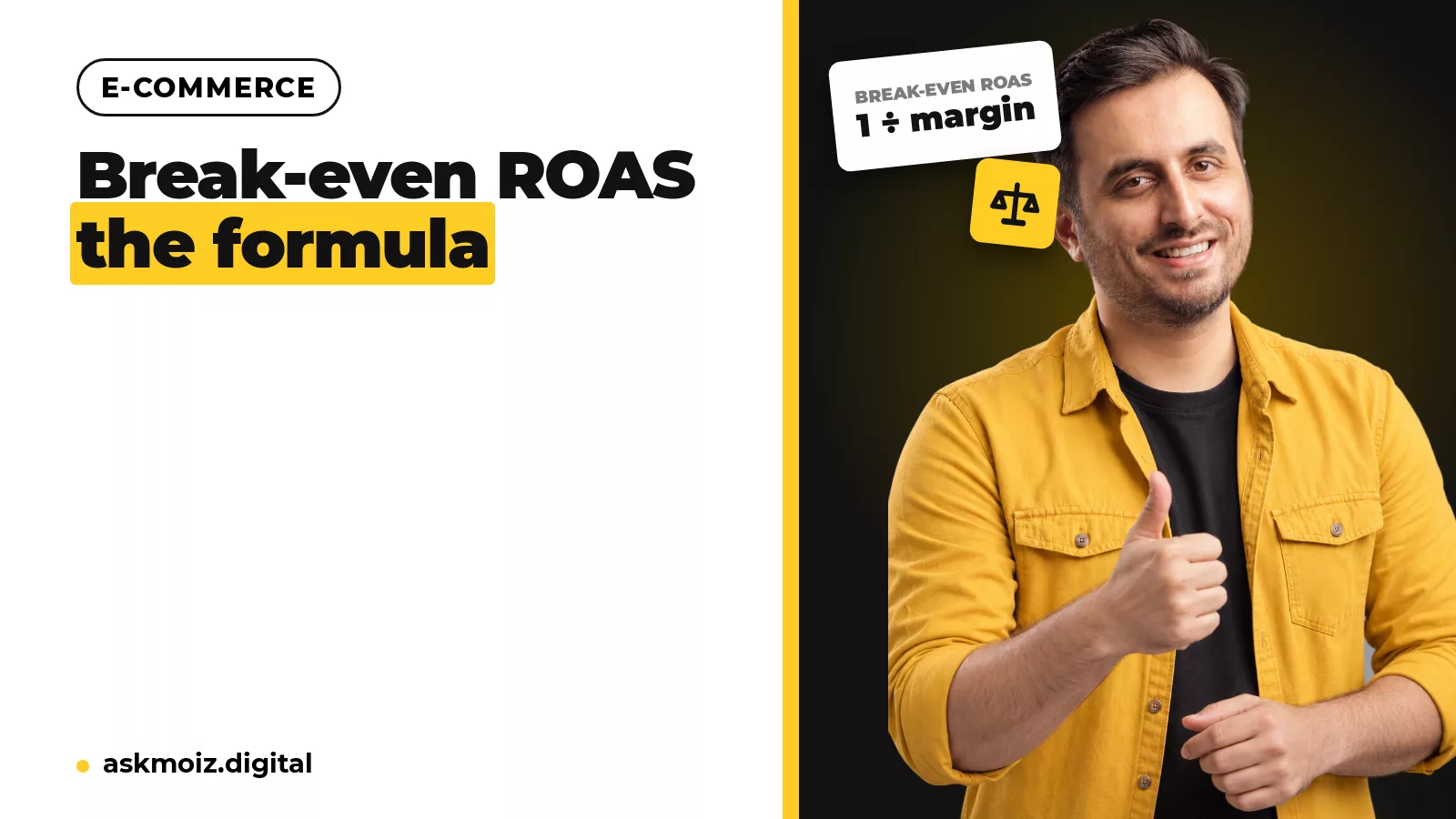
Break-even ROAS is 1 divided by your contribution margin, where margin is the share of each sale left after product cost, shipping, payment fees and returns, before ad spend. At a 40% margin your break-even ROAS is 2.5. Below it, every ad sale loses money.
Find your break-even ROAS
- Take the selling price
- Subtract every cost per order
- Divide profit by price
- Divide 1 by that margin
- Compare with your ROAS
In this post
If you don't know your break-even ROAS, you can't tell whether a campaign with a ROAS of 3 is winning or losing. It depends entirely on your margin.
The formula is short. The part most guides skip is which margin to put into it. Get that wrong and you will overspend while the dashboard looks fine.
What is the break-even ROAS formula?
Break-even ROAS is the return on ad spend at which your ads exactly pay for themselves. You work it out by dividing 1 by your contribution margin.
Break-even ROAS = 1 / contribution margin
Contribution margin is the share of each sale left after every cost of making and delivering the order, before ad spend.
ROAS is revenue divided by ad spend. If a 40% slice of each sale is yours to keep, then for every 1 you spend on ads you need 2.5 in sales just to get that 1 back. That is where 1 / 0.40 = 2.5 comes from.
What does a worked example look like?
This is an example only, with round numbers. It is not a result from any store.
- Selling price: 50.
- Product cost: 18. Shipping and packaging: 6. Payment fees: 2. Allowance for returns: 4.
- Total cost per order: 30. Left over before ads: 20.
- Contribution margin: 20 / 50 = 0.40, or 40%.
- Break-even ROAS: 1 / 0.40 = 2.5.
Check it. Spend 100 on ads at a ROAS of 2.5 and you sell 250. That is 5 orders at 50. Each leaves 20 before ads, so 5 orders leave 100. You spent 100. You made exactly nothing, which is what break-even means.
What is the break-even ROAS for each margin?
Use this table as a quick lookup, then do the sum for your own numbers.
| Contribution margin | Break-even ROAS | Max ad cost per 50 sale |
|---|---|---|
| 20% | 5.00 | 10.00 |
| 25% | 4.00 | 12.50 |
| 30% | 3.33 | 15.00 |
| 40% | 2.50 | 20.00 |
| 50% | 2.00 | 25.00 |
| 60% | 1.67 | 30.00 |
| 70% | 1.43 | 35.00 |
The last column is the same answer seen as a cost per order: the most you can pay in ads to win one sale of 50 and still break even.
Which margin should I use?
Use contribution margin, not gross margin. This is the trap. Gross margin only takes off the product cost. Say the product cost 18 on a price of 50: that is a gross margin of 64%, and a break-even ROAS of 1.56. It looks comfortable.
But shipping, payment fees and returns also come out of that order. After them you keep 40%, and the real break-even is 2.5. A store that trusts the 1.56 and runs at a ROAS of 2 thinks it is profitable. It is losing money on every sale.
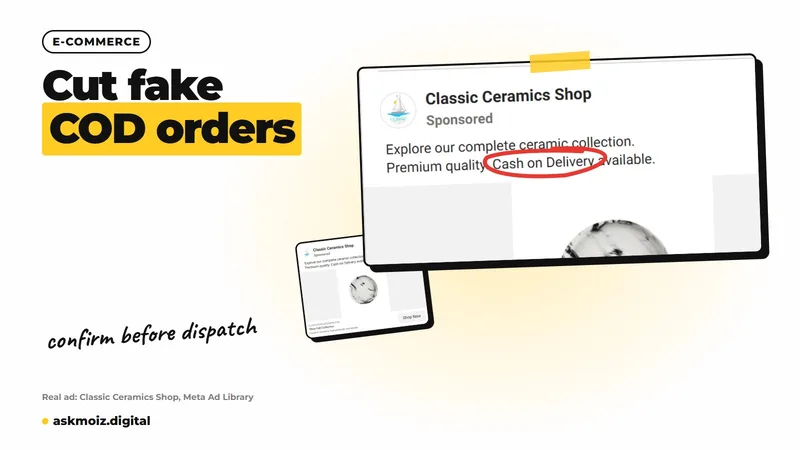
Returns are the easiest cost to forget. If you sell cash on delivery, or in any category with high returns, put a realistic return allowance in the sum. I cover the order side in cutting fake COD orders with WhatsApp confirmation.
How do I get from break-even to a profit target?
Break-even is the floor. You want to be above it. To aim for a profit, subtract the profit you want, as a share of revenue, from your margin before you divide.
Target ROAS = 1 / (contribution margin - profit you want). With a 40% margin and a goal of keeping 10% of revenue after ads: 1 / (0.40 - 0.10) = 3.33. At a ROAS of 3.33, a 100 ad spend brings 333 in sales, and you keep about 33 after ads.
How do I compare it with the ROAS in my dashboard?
Don't compare break-even ROAS with a number that includes sales you never keep. Ad platforms count a purchase when it happens. A returned order stays in the count unless you remove it, for example with a conversion adjustment in Google Ads. Compare your break-even number with ROAS on sales that stayed sold. I explain the difference in ROAS vs POAS vs blended ROAS.
- Take the selling price of one order, after any discount.
- Subtract every cost of making and delivering it: product, packaging, shipping, payment fees, a return allowance.
- Divide what is left by the price. That is your margin.
- Divide 1 by the margin. That is your break-even ROAS.
- Redo it for every offer. A discount cuts margin and raises the number you need.
Last point: a discount changes the answer. Take 10 off a 50 order and, if your other costs stay the same, the margin drops from 40% to 25%. Break-even ROAS goes from 2.5 to 4. The same ad now has to work 60% harder.
After 13+ years in this work, this is the first sum I do before I look at any ad. If you want to work out your own break-even number with me, book a strategy call.
Common questions
What is break-even ROAS?
It is the return on ad spend at which your ads exactly pay for themselves. Divide 1 by your contribution margin. At a 25% margin it is 4. Above that number the ads make money, below it they lose money.
How do I calculate break-even ROAS?
Subtract product cost, shipping, payment fees and an allowance for returns from the selling price. Divide what is left by the price to get your margin. Then divide 1 by that margin.
Is break-even ROAS the same as target ROAS?
No. Break-even ROAS is the floor where you make nothing. Target ROAS is the number you aim for, which must be higher because you want profit. Work it out as 1 divided by (margin minus the profit share you want).
Should I use gross margin or contribution margin?
Use contribution margin. Gross margin ignores shipping, fees and returns, so it gives a break-even number that is too low and hides losses.
Got a question this didn't answer? Message me on WhatsApp.
Sources
- Google Ads Help: About conversion adjustments, Google Ads Help. Checked 2026-11-07.

Written by Moiz Khan
Meta and Google Ads consultant, 13+ years in ad accounts
I'm Moiz Khan. I've spent 13+ years inside Meta and Google ad accounts and managed $12M+ in ad spend, for e-commerce and service businesses in Pakistan and abroad. Here I write down what I check, what I change and why, so you can fix your own account or know what to ask for.